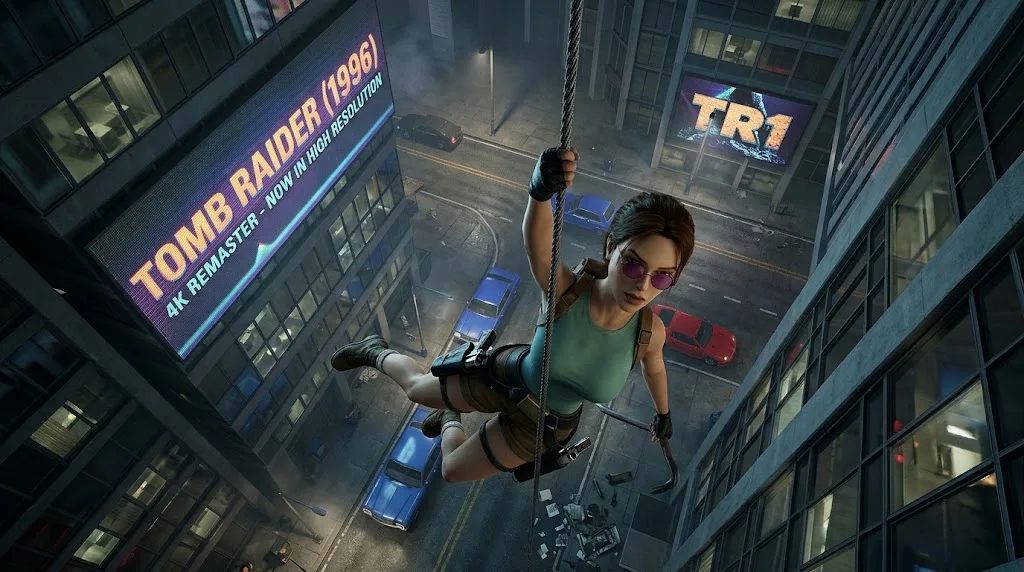
Tomb Raider reached its 30th birthday this week. The original game arrived on 24 October 1996, and the series has since passed 100 million copies sold. Few franchises last that long. Fewer still survive the mistakes this one made along the way.
That is exactly why it is worth studying. Tomb Raider is not a story of a flawless run. It is a thirty year case file on what goes wrong when a hit game is turned into a machine, and what goes right when a team stops, regroups and rebuilds.
At ND Marketing Services, we design and build games for a living, so we read case files like this one closely. Here are the biggest mistakes in Tomb Raider’s history, and the lessons we take from each into our own work.
Mistake 1: Turning a hit into a calendar
The first game was a runaway success. Core Design’s answer was to ship a new Tomb Raider every year for four years, which put real strain on the staff. One industry report describes five annual releases between 1996 and 2000, all of them multi-million sellers.
The sales looked brilliant. The team was a different matter. Annual deadlines leave no space to rethink the core design, so each sequel tends to polish the last one rather than push forward. Then comes a gap of three years before the next big release, and the studio has no breathing room left to prepare for it.
The lesson. A release cadence should come from your production capacity, not from your last sales chart. We build schedules backwards from a vertical slice, then add recovery time between milestones. A team that is allowed to rest produces better ideas.
Mistake 2: Letting the creative anchor walk away
The original game was created by Toby Gard and Paul Douglas. Reporting from the time notes that Gard left Core Design after the first game to set up his own studio. The series carried on, but the person who understood why Lara moved, felt and explored the way she did was no longer in the room.
Gard did return to the franchise later, working with Crystal Dynamics. The point stands. Design knowledge that lives in one head is a risk.
The lesson. Write the design down. Not as a vast document nobody reads, but as a short, living set of principles: what the player should feel, what the camera must never do, what the character will never say. We help clients build exactly that kind of design pillar document in the first weeks of a project.
Mistake 3: Moving to new technology without a plan for it
Tomb Raider: The Angel of Darkness is the textbook example. Development began three years before its 2003 release. An industry profile from the time describes a project beset by technical problems, a diffuse design focus and a development cycle that ran well over three years, partly because of the shift between console generations.
The game still sold 2.5 million copies worldwide. That figure matters, because it shows how misleading a sales number can be. Strong sales did not stop the publisher moving the franchise to Crystal Dynamics, and planned sequels were scrapped.
The lesson. New hardware means new unknowns. We treat any technology jump as its own risk, with its own stage gate. Before a studio commits to a full production schedule, we ask for a playable slice running on the new tech. If it cannot be built in a small space, it will not survive a large one.
Mistake 4: Running parallel versions of the same idea
After the troubles of 2003, the franchise changed hands. Yet reports suggest Core Design was also working on its own Anniversary remake at the same time as Crystal Dynamics was building the version that eventually shipped. Two teams, two visions, one brand. Eidos later cancelled the Core version in favour of keeping development at Crystal Dynamics.
It is a quiet mistake, but an expensive one. Effort that never reaches players is the most costly kind a studio can spend.
The lesson. One IP needs one roadmap and one owner. When we work alongside a publisher or a partner studio, we agree who owns which decision before anyone opens an editor.
Mistake 5: Forecasting on review scores instead of players
The 2013 reboot is often remembered as a triumph, and in the long run it was. But on launch it was labelled a disappointment. It sold 3.4 million copies in its first month, while Square Enix had expected between five and six million. The company said it was very disappointed that high review scores had not translated into sales.
Then the long tail arrived. The reboot passed 8.5 million copies by 2015, a franchise record, and later reporting put the figure near 11 million. By our own arithmetic, that final figure is roughly 1.4 to 1.7 times the eventual 2015 number set against the original forecast range, which tells you how badly a first month can mislead. Square Enix’s own president later pointed out that the game had arrived just before a financial year end, when expectations were already high.
The lesson. Reviews are not revenue, and a launch month is not a lifetime. We help studios build sales models that include discounts, platform re-releases and catalogue performance, so a strong game is not written off in week four.
Mistake 6: Trading reach for a platform deal
Rise of the Tomb Raider launched as a timed Xbox exclusive. It reached PC a few months later and PlayStation 4 a full eleven months after launch. The series total for the reboot era came to nearly 7 million for Rise, against 11 million for its predecessor. Exclusivity was likely a factor, though not the only one.
Platform money is real and useful. But it comes with a hidden cost: every month a game is missing from a major platform is a month of word of mouth that cannot happen.
The lesson. Model the trade before you sign it. We put a number on the audience a timed deal removes, then compare it with the money offered. Sometimes the deal still wins. It should never be a guess.
Mistake 7: Letting a milestone date outrun the build
The 30th anniversary was meant to be a showcase. Tomb Raider: Legacy of Atlantis, a ground-up reimagining of the first game built in Unreal Engine 5, was originally slated for 2026. It now arrives on 12 February 2027, which pushes it outside the anniversary year.
We would not call a delay a failure. Shipping late beats shipping broken. The mistake, if there is one, is attaching a marketing moment to a date the production team had not yet earned. The anniversary has gone ahead anyway, with collaborations, a book and even a museum exhibition in the series’ birthplace of Derby.
The lesson. Marketing and production should share one calendar. We never announce a window until the team can show us a build that proves it.
What Tomb Raider Got Right
It would be unfair to end on the stumbles. Tomb Raider recovered from the lowest point in its history by handing the series to a new team, reinventing the character and rebuilding the formula. It has stayed relevant for three decades through remasters, reboots and a willingness to start again.
That resilience is the real lesson. The best studios are not the ones that never make mistakes. They are the ones that spot them early, say so out loud, and fix them while the fix is still cheap.
How ND Marketing Services Builds Differently
We design games with these case files open on the desk. In practice that means:
- Concept and prototype. A playable vertical slice before any large commitment, so risk shows up in week six rather than year three.
- Design pillars. A short, living document that keeps the creative vision intact when people join or leave.
- Production planning. Schedules built from team capacity, with recovery time and honest buffers.
- Launch and live strategy. Sales models that look beyond the first month, and platform decisions made with numbers rather than hope.
- Co-development. Clear ownership and one roadmap when we work beside publishers and partner studios.
Whether you are sketching a first idea or rescuing a project that has slipped, we would be glad to talk. [Add your contact link or booking page here.]
Final Thoughts
Lara Croft at 30 is a reminder that games are made by people, on schedules, under pressure. Her biggest mistakes were not about puzzles or polygons. They were about pace, ownership, planning and timing. Learn from them, and your game gets a little closer to still being loved in thirty years.
References
365 Military (2026) Chronicles of the Tomb Raider Celebrates 30 Years of Lara Croft This October: (Accessed: 25 October 2026).
Game Developer (2024) Tomb Raider franchise tops 100 million sold copies. (Accessed: 25 October 2026).
Wikipedia (n.d.) Tomb Raider: (Accessed: 25 October 2026).
Wikipedia (n.d.) Tomb Raider: The Angel of Darkness. (Accessed: 25 October 2026).
MCV UK (n.d.) IP profile: Tomb Raider.(Accessed: 25 October 2026).
GamesIndustry.biz, summarised in Slashdot (2004) Tomb Raider company founders regroup in Circle. (Accessed: 25 October 2026).