Smart Choice Granny Flats

Industry: ADU / Granny Flat Construction | Engagement: 2020–2022
At a Glance
| Metric | Result |
| Organic traffic index | 100 → 350 (+250%) |
| Primary ranking | #1 for “granny flat builder [region]” |
| Quote requests | 0.8 |
Overview
Smart Choice Granny Flats builds secondary dwellings: self-contained homes on the same property as a main house. It is a high-consideration purchase, involving large budgets, council rules and real uncertainty for homeowners. The business had strong craftsmanship and happy customers, but its online visibility did not reflect it. This case study covers how a two-year SEO program turned the company’s expertise into organic demand and made it the leading result in its region.
The Challenge
The core problem was vocabulary. Many homeowners who could benefit from a granny flat did not know the term, or used others such as “ADU”, “backyard unit”, “secondary dwelling” or “in-law suite”. Terminology varies by country and even by city. Demand existed, but it was scattered across many phrasings, and a large share of it was not searching for a builder at all. These people were asking questions first.
Two kinds of intent at once
The brand needed to win two very different audiences:
- Informational intent: homeowners researching whether a granny flat was allowed, how permitting worked and what it would cost.
- Commercial intent: homeowners who had decided to build and were comparing local builders.
A site focused only on services would miss the first group. A blog focused only on education would fail to convert. The strategy had to connect the two so that a reader who arrived with a question could progress naturally to requesting a quote.
Strategy
The guiding idea was simple: teach first, then prove, then convert. Content would build awareness and trust, local pages would capture high-intent searches, and social proof would close the decision.
Execution
1. On-Page SEO
Educational content cluster. We built a connected set of guides around the questions homeowners ask before they ever contact a builder:
- Regulations: what is allowed, where, and under what conditions.
- Permitting guides: step-by-step explanations of approvals and timelines.
- Cost breakdowns: transparent explanations of what drives price.
These pieces were interlinked and used a mix of search terms, so a person searching “can I build a second home in my backyard” and a person searching “granny flat” could both arrive at the same helpful resource. Each guide pointed readers to relevant next steps, including consultations and quote requests, bridging informational and commercial intent.
Local landing pages by service region. Because buyers search by location, we created dedicated pages for each region served. Each page addressed local conditions and regulations, showcased relevant projects and carried clear calls to action. This is what supported the #1 ranking for “granny flat builder [region]”.
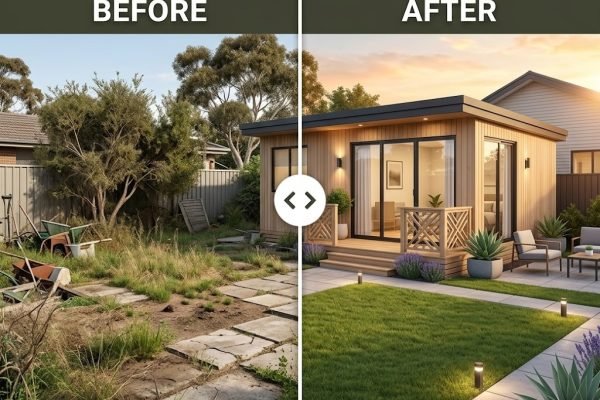
Image SEO on before/after galleries. Building work is visual, and the portfolio was one of the company’s strongest assets. We structured the before/after galleries so images could be understood by search engines and discovered through image search, turning completed projects into both ranking signals and persuasion tools.
2. Off-Page SEO
Local mentions and citations. We strengthened the brand’s local footprint through consistent business listings and mentions in regional sources, reinforcing relevance and credibility for location-based searches.
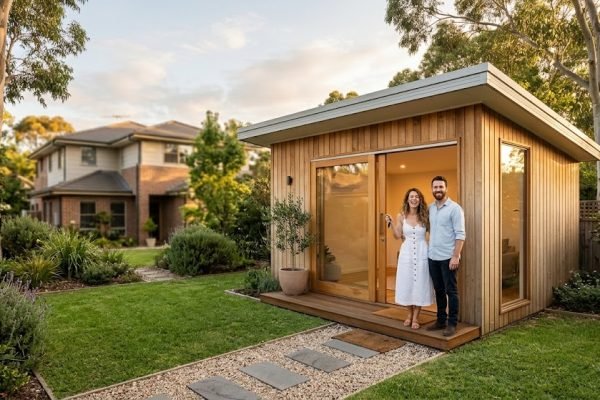
Testimonial-driven trust. Customer feedback was treated as a core marketing asset. Testimonials were gathered, featured prominently and used throughout the site, because in a purchase this large, other homeowners’ experiences carry more weight than any claim the company could make about itself.
3. Technical Fixes
Review and testimonial schema. Structured data was implemented so search engines could recognise customer reviews and testimonials, supporting richer search listings and stronger trust signals directly in results.
Gallery image optimization. Galleries were made faster and more accessible through descriptive alt text and image compression. This improved page speed, usability on mobile and the visibility of the images themselves.
Results
Over the two-year engagement, organic traffic grew steadily and compounded:
Stage | Organic Traffic Index |
|---|---|
Start | 100 |
End of Year 1 | 200 |
End of Year 2 | 350 |
This is a 250% increase over the engagement. Growth was consistent rather than spiky, which is typical of an education-led strategy where content builds authority over time.
Beyond traffic, the business outcomes were clear:
- #1 ranking for "granny flat builder [region]", the company's highest-value commercial term.
- 80% increase in quote requests, showing that the added visibility translated into real sales opportunities rather than vanity metrics.
Why It Worked
- It met people where they were. Instead of competing only for people who already knew what to search for, the content captured people at the very start of their journey.
- It matched content to intent. Guides handled research, local pages handled selection and galleries and reviews handled the final decision.
- It made trust visible. Schema, testimonials and project imagery gave both search engines and customers evidence of quality.
- It compounded. Each guide and local page added to a growing base of authority, so results built on one another year over year.
Key Takeaways
- When a market lacks the vocabulary to search for your product, education is the SEO strategy.
- For considered, high-value purchases, proof (visuals and reviews) converts the traffic that guides attract.
- Local pages and local trust signals are essential for service businesses where customers choose a nearby provider.
- Technical details like schema and image optimization are small on their own, but together they make existing assets work harder.
Summary
People did not know what to search for, so the content taught them. Guides answered planning questions, while galleries and reviews closed the deal. The result was a brand that moved to #1 in its region and a sales pipeline with 80% more quote requests.