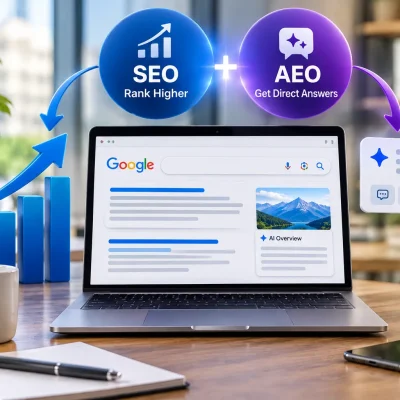
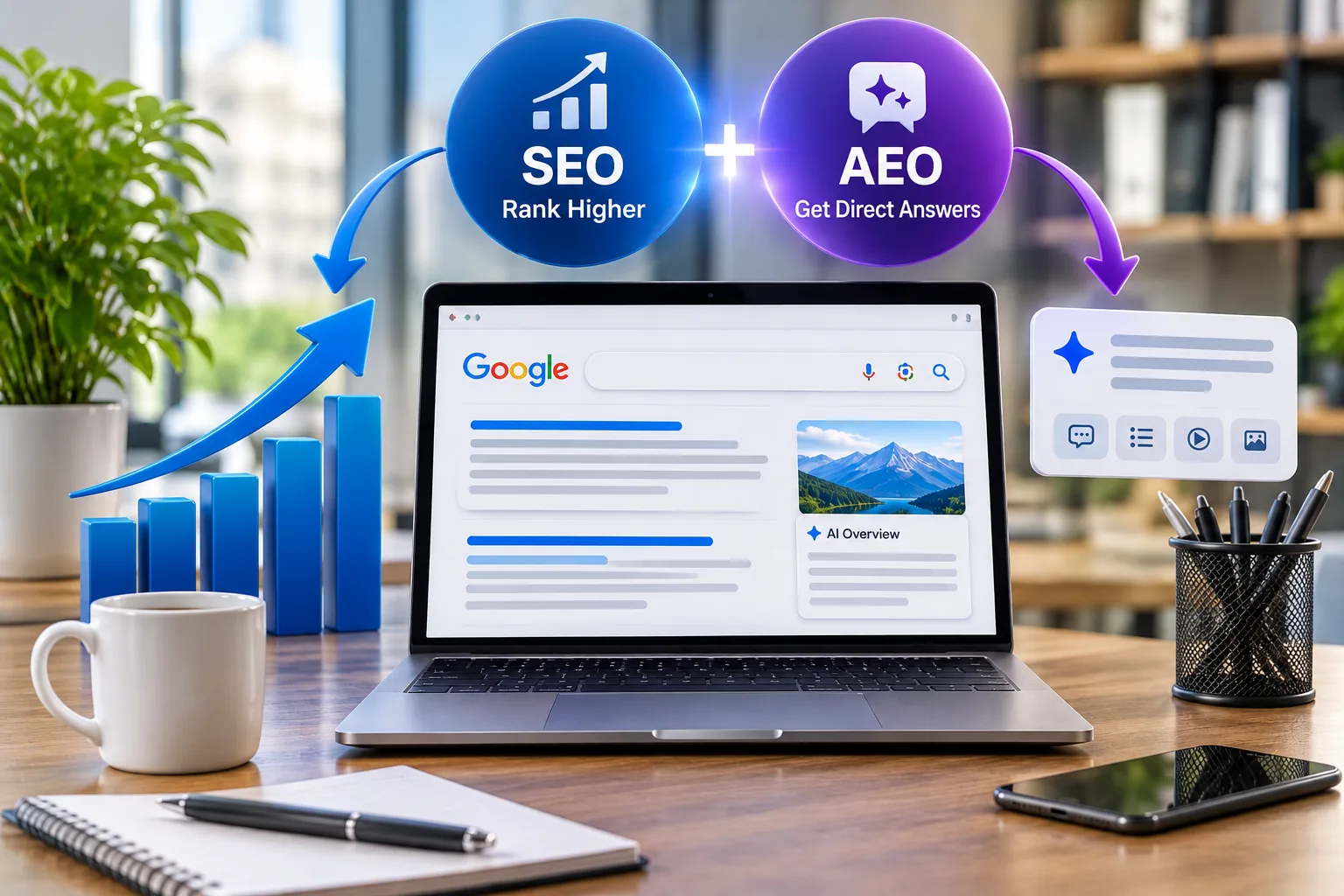
Quick answer: To add AEO (Answer Engine Optimisation) to your search strategy, keep your SEO foundations and build on them. Make each important page answer one clear question in its opening lines, back it with original evidence, keep your brand details consistent across the web, and track citations in AI tools next to your rankings. Google itself says optimising for AI search is still SEO, so you are extending a plan, not replacing it.
Key takeaways
- AI Overviews are linked to sharply lower click-through rates, with studies reporting falls of 34.5% to 58% for the top result.
- AI platforms still send a small slice of traffic, between roughly 0.3% and 1.1% of visits depending on the study, but that slice is growing fast.
- Google says there is no special markup, file or trick for AI features. Crawlable, useful, original content is what counts.
- The most practical AEO habits are answer-first writing, original data, consistent brand signals and better measurement.
- You can start with ten pages and a 90-day plan.
Rankings used to be the finish line. You climbed to position one, the clicks arrived, and everybody went home happy. That bargain has quietly broken.
Search engines now answer a good share of questions before anyone touches a blue link. Plenty of people skip Google altogether and ask an AI assistant instead. If your strategy still treats page one as the whole prize, you are measuring a game whose rules have changed.
The good news? Nothing needs tearing down. AEO is best seen as a layer on top of solid SEO, not a substitute for it. This guide covers what the latest research says, what Google has told site owners, and how to build AEO into the plan you already have.
What is AEO, and how does it differ from SEO and GEO?
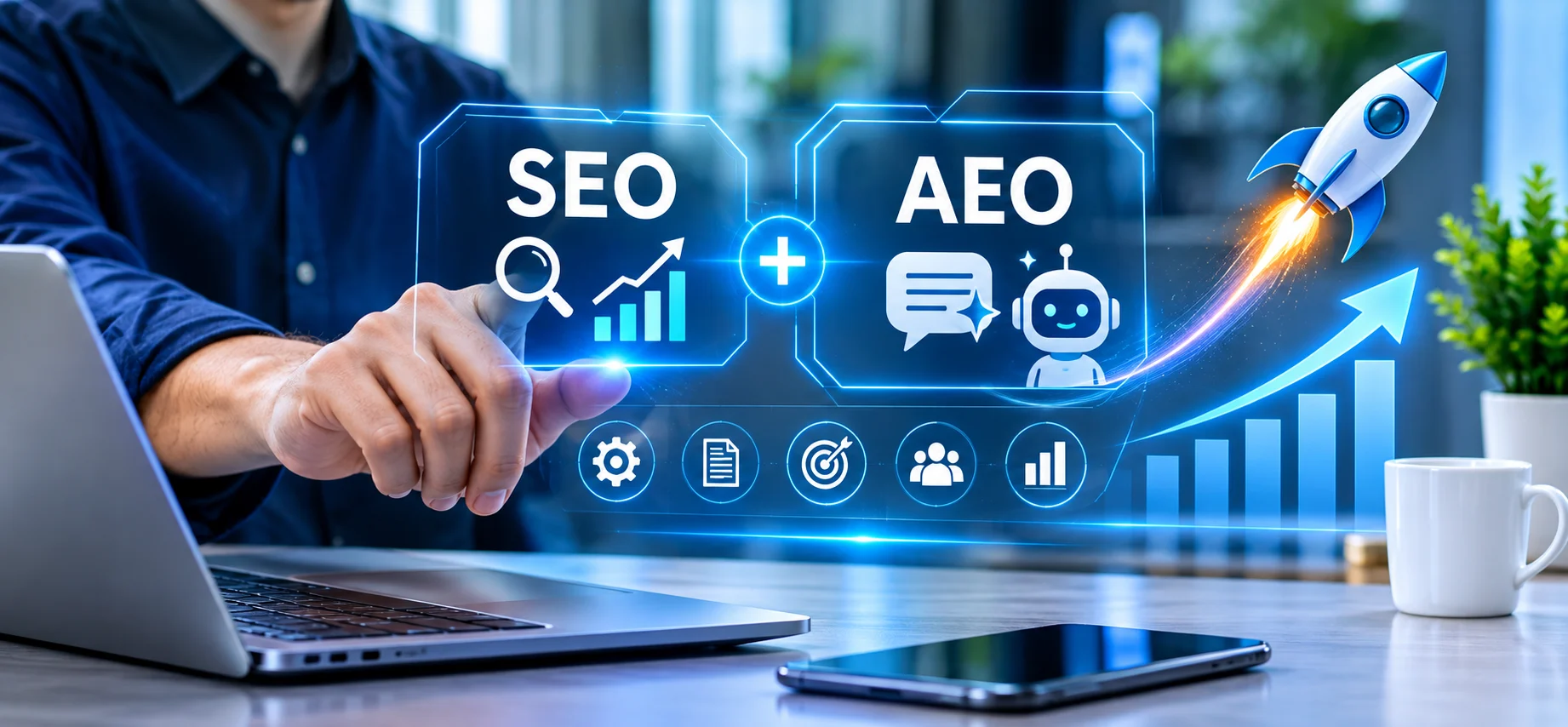
AEO is the practice of shaping your content and brand so that answer engines can find, understand, trust and quote you. Those engines include Google AI Overviews and AI Mode, ChatGPT, Gemini, Perplexity, Copilot and Claude.
You will also hear the term GEO, short for Generative Engine Optimisation. In day-to-day work the two overlap so heavily that the split is mostly branding. Both ask the same thing: when somebody wants an answer, does your business appear inside it?
Traditional SEO | AEO / GEO | |
|---|---|---|
Main goal | Rank pages in search results | Be cited or recommended inside generated answers |
Unit of success | Position and click | Mention, citation and brand recall |
Content style | Keyword-focused pages | Question-led pages with direct answers |
Key signals | Links, relevance, technical health | Original evidence, consistent brand signals, clear text |
Main measures | Rankings, sessions | Citations, branded search, AI referrals, conversions |
What AEO is not matters just as much. It is not a secret file. It is not a magic block of markup. And it is certainly no reason to drop keyword research, technical health or link building.
Why does AEO matter now?
Because clicks are falling on queries where AI answers appear, while AI platforms are slowly becoming a traffic source of their own.
Ahrefs has run its AI Overviews click study twice. The 2025 version analysed 300,000 keywords and found that an AI Overview was linked to a 34.5% lower click-through rate for the top-ranking page. The 2026 update compared December 2023 with December 2025 and put the figure at 58%. Position two lost about 51% of its clicks, and even position ten lost around 19%. The damage reaches well beyond the top spot.
Correlation is one thing; cause is another. A pre-registered randomised field experiment, run between January and February 2026, tried to isolate the effect. AI Overviews appeared on 42% of queries and cut outbound organic clicks by 38% where they showed. Zero-click searches rose from 54% to 72%. People who had the summaries removed did not report being any less satisfied. Earlier Pew Research data points the same way: users clicked a result 8% of the time when an AI summary appeared, compared with 15% when it did not.
There is a more hopeful reading too. Seer Interactive tracked 5.47 million queries and 2.4 billion impressions, and reported that organic click-through rate on searches with an AI Overview rose from 1.3% in December 2025 to 2.4% in February 2026. That is a recovery of sorts, though from a very low base. The picture is still moving.
How much traffic do AI platforms actually send?
Not much yet, but the direction is clear. Three large 2026 studies measured the share of website visits coming from AI tools, and they do not agree on the exact figure:
Study | Sample | AI share of website traffic |
|---|---|---|
SE Ranking | Global website data | 0.32% in 2026, up from 0.24% in 2025 and 0.02% in 2024 |
Conductor | 13,770 domains, 3.3 billion sessions | 1.08% |
SEOcrawl | 16,000+ websites | 0.36% overall, reaching 0.42% in August 2026 |
The gap comes down to method, and a good deal of AI-driven traffic is never labelled as such in analytics. Even so, every study shows growth. SE Ranking calls it a 16-fold rise in under two years, or roughly one visit in every 312.
The mix of platforms is shifting as well. SE Ranking found ChatGPT behind about 75% of AI referrals, followed by Gemini (11.6%), Perplexity (7.2%), Copilot (3.5%) and Claude (2.6%). Claude grew fastest in percentage terms, up 320% year on year. SEOcrawl, looking at March to August 2026, saw ChatGPT even higher at 83%, with Perplexity referrals roughly halving.
One word of caution on quality. Several vendor studies claim AI-referred visitors convert better than ordinary organic visitors, with one benchmark citing 3.49% against 2.86%. Those figures are vendor-reported and vary wildly by sector, so test them against your own analytics before building a business case on them.
What has Google said about optimising for AI search?
Google’s position is that optimising for generative AI features is still SEO. On 15 May 2026 it published its first dedicated guide, titled “Optimizing your website for generative AI features on Google Search”, building on its existing documentation about AI features and your website.
Search Engine Journal’s reading of the guide is that structured data is not required for generative AI search, and that there is no special schema.org markup to add. Other commentary adds that special AI text files such as llms.txt are unnecessary for Google, and so is chopping content into tiny “chunks” for machines. Google’s documentation points back to fundamentals instead: keep important content in text form, allow crawling through robots.txt and any CDN or host, support pages with good images and video, link internally so content is easy to find, and deliver a good page experience.
There is a catch worth remembering. That guidance covers Google’s own AI features. As Search Engine Journal points out, it does not settle how ChatGPT, Perplexity and others weigh their signals. So the sensible order is this: get the SEO fundamentals right first, then add the AEO habits that help any engine read, trust and quote you.
The theme repeated most often in expert commentary is what some call non-commodity content, meaning pages that say something only your brand can say, backed by original data, proprietary research or real customer outcomes. If a model can write your article from general knowledge, it has little reason to cite you.
How do you add AEO to your search strategy? Eight steps
Step 1: Fix the technical foundations first
An answer engine cannot quote a page it cannot reach, so check the plumbing before writing a single new word.
- Crawlability. Confirm that robots.txt, your CDN and your hosting are not blocking the bots you want. Review the user agents used by AI search tools, such as OpenAI’s search crawler and PerplexityBot, and decide on purpose which to allow.
- Text availability. Key facts should sit in HTML text, not locked inside images, PDFs or content that only appears after heavy scripts run.
- Page experience. Slow, clumsy pages lose people, and they lose citations too. If your site drags, a proper web development and optimisation pass beats any AI-flavoured tweak.
- Order of work. Not every issue carries equal weight, which is why the order of your technical SEO fixes matters as much as the fixes themselves.
It is dull work. It is also the work everything else rests on.
Step 2: Rebuild keyword research around real questions
Traditional keyword lists chase short phrases, whereas answer engines are fed by full questions, often long and specific. Think “which accountancy software suits a ten-person charity?” rather than “accounting software”.
To find those questions, look at:
- People Also Ask boxes and related searches for each core topic.
- Customer emails, sales call notes and live chat logs, which hold the best real phrasing.
- Forum and community threads where your audience asks for help.
- Search Console queries that already contain who, what, how, why, which or “vs”.
Sort the questions by intent: informational, comparison and transactional. Ahrefs found that 99.2% of keywords triggering AI Overviews in its sample were informational, so that is where the pressure lands first.
Step 3: Write answer-first, then add depth
Open every section with a direct, self-contained answer in one to three sentences, then expand with context, evidence and caveats. This is the single most practical AEO habit.
Compare these two openings.
Weak: “There are many factors to consider when thinking about how long SEO takes.”
Stronger: “Most businesses see early movement from SEO within three to six months, though competitive markets can take longer. Here is what drives the difference.”
The second version can be lifted into an answer without losing its meaning, and it reads better for humans too, which is rather the point. Google’s own advice is to organise content for people with clear paragraphs and descriptive headings, not to contort it for machines.
A small tip: phrase some of your headings as the question people actually type. It helps readers scan, and it gives engines a clean question-and-answer pair to match.
Step 4: Create content that is hard to replace
Give models a reason to cite you. That means:
- Publishing original data, even from a small sample. A survey of 100 customers beats a recycled statistic.
- Adding first-hand experience: screenshots, worked examples, honest mistakes, real prices.
- Taking a clear position and defending it.
- Naming the author and showing why they are qualified to speak.
If you are experimenting with AI in your own workflow, our guide to using AI as your SEO and GEO consultant shows where it helps and where a human still has to make the call. More analysis sits in our insights hub.
Step 5: Use structured data sensibly
Structured data will not guarantee a citation. Google says there is no special markup for AI features. It still earns its place, though, because it supports rich results such as review stars and local business details, and it hands crawlers explicit, machine-readable facts instead of leaving them to guess.
The rules are simple. Use JSON-LD. Mark up only what is visible on the page, since Google requires structured data to match the visible text. Validate it. Then stop fiddling and go back to improving the content.
Step 6: Build brand and entity signals
Answer engines read more than your website. They also read what the wider web says about you, so consistency matters.
- Keep your business name, address, description and services identical across your site, Google Business Profile, directories and social profiles.
- Earn genuine mentions through industry press, podcasts, expert roundups, reviews and community discussion.
- Collect customer reviews and reply to them.
Google warns that chasing inauthentic mentions is less helpful than it might seem, because its core ranking systems reward quality and its spam systems filter the rest. Earn mentions slowly, or do not bother.
Step 7: Go beyond plain text
Google recommends supporting text with high-quality images and video where they add value. Short explainer videos, clear diagrams and well-labelled comparison tables all give engines, and readers, more to work with. Keep tables simple and genuinely useful.
Step 8: Measure what matters
If you only watch rankings and organic sessions, you will misjudge the situation. Build a small AEO dashboard instead:
- Impressions and click-through rate by query type in Search Console. Falling clicks with steady impressions is the classic signature of an AI-answer effect, not necessarily a ranking problem.
- Branded search volume. If more people search for you by name, your visibility is working even when the click path is invisible.
- AI referral sessions in analytics, split by source (ChatGPT, Gemini, Perplexity, Claude, Copilot). Remember that some traffic arrives unlabelled.
- Citation checks. Each month, put 20 to 30 priority questions to the main assistants and record whether your brand is mentioned or linked.
- Conversions and revenue, not just visits. Small volumes can still matter when the visitors are well qualified.
Seer’s findings suggest that appearing in AI answers may influence awareness and consideration much as featured snippets once did, even when the click path looks different.
What does a realistic 90-day AEO plan look like?
A workable plan runs in three phases of roughly 30 days each: audit and repair, rewrite and fill gaps, then promote and test.
Days 1 to 30: audit and repair. Run a technical audit. Check crawler access. Pick your twenty most valuable pages and list the questions each should answer. Set up the measurement dashboard so you have a baseline.
Days 31 to 60: rewrite and fill gaps. Rework the top pages with answer-first openings, clearer headings and added evidence. Publish five to ten new pieces aimed at high-intent questions you do not yet cover. Tidy your structured data and entity details.
Days 61 to 90: promote and test. Pitch your original data to relevant publications. Gather reviews. Run your first citation check, compare it with the baseline and decide which pages deserve more investment.
If you would rather not carry this alone, an experienced team can fold it into a wider plan. You can see what that looks like in our success stories or simply get in touch.
What mistakes should you avoid?
- Abandoning SEO. The AI layer still leans on core search systems. Neglect the base and the top collapses.
- Chasing hacks. Special files and tricks are tempting, yet Google’s guidance points away from them.
- Writing for bots. Robotic, fragmented copy damages the very experience that earns trust.
- Judging success by clicks alone. Visibility inside an answer has value even without a visit.
- Trusting a single benchmark. The studies above differ by a factor of three on AI traffic share. Your own data is the only data that counts.
- Expecting overnight results. Like conventional SEO, this compounds over months.
Frequently asked questions
Is AEO different from SEO?
They overlap heavily. SEO helps you get found and ranked, while AEO helps you get quoted and recommended. Google describes optimising for generative AI search as optimising for the search experience, which makes it still SEO.
Do I need schema markup to appear in AI Overviews?
No. Google says no special schema is required for its AI features. Use structured data for rich results and accurate machine-readable facts, but do not expect it to secure a citation.
Do I need an llms.txt file?
Google’s guidance indicates you can skip special AI files for its own features. Other engines may behave differently, so treat llms.txt as optional rather than essential.
How long does AEO take to work?
Expect early signals within a few months, much like SEO. Citation patterns can shift quickly, so monthly checks are worthwhile.
Will AI search kill organic traffic?
Clicks are certainly falling on many informational queries, but AI referral traffic is small and growing, and early evidence suggests click-through rates on AI Overview searches may be stabilising. Nobody knows yet how it will settle, which is the strongest argument for spreading your visibility across more than one channel.
Final thoughts
Adding AEO is less a revolution than a sharpening. You keep the fundamentals: crawlable pages, relevant content, sound links. You add clearer answers, original evidence, consistent brand signals and better measurement. And you accept that visibility and clicks are no longer the same thing.
Start small. Pick ten pages, make each one the best answer on the web, then measure, learn and repeat.
References
- Ahrefs (2025). AI Overviews Reduce Clicks by 34.5%. https://ahrefs.com/blog/ai-overviews-reduce-clicks/
- SEOworth (2026). Ahrefs: AI Overviews Cut the Top Result’s CTR by 58%. https://seoworth.it.com/news/ahrefs-ai-overviews-ctr-study/
- Search Engine Journal (2026). Study Confirms Google AI Overviews Cut Organic Clicks 38%. https://www.searchenginejournal.com/ai-overviews/445029/
- Search Engine Journal (2026). Google’s AI Overviews Cut Clicks Without Satisfaction Gain: Report (citing Pew Research). https://www.searchenginejournal.com/ai-overviews-cut-organic-clicks-38-field-study-finds/573145/
- Herdl (2026). New Study Finds Google Click-Through Rates Are Increasing for Organic Searches with AI Overviews (reporting Seer Interactive data). https://herdl.com/new-study-finds-google-click-through-rates-are-increasing-for-organic-searches-with-ai-overviews/
- Google Search Central. AI features and your website. https://developers.google.com/search/docs/appearance/ai-features
- Search Engine Journal (2026). Google’s New AI Search Guide Calls AEO and GEO ‘Still SEO’. https://www.searchenginejournal.com/googles-new-ai-search-guide-calls-aeo-and-geo-still-seo/575026/
- Previsible (2026). Google Just Published Its First Official Guide to AI Search Optimization. Here’s What Actually Matters. https://previsible.io/?p=846
- Nebo Agency (2026). The TL;DR on Google’s New AI Search Guidelines. https://www.neboagency.com/blog/the-tldr-on-googles-new-ai-search-guidelines/
- SE Ranking (2026). AI Traffic Grew 16x from 2024 to 2026: Here Are the Top AI Search Engines Driving Visits to Websites. https://seranking.com/blog/ai-traffic-research-study/
- Remote Work Europe (2026). Conductor’s 2026 AEO/GEO Benchmarks Report: AI Referrals at 1.08% of Traffic. https://remoteworkeurope.eu/news/2026/conductor-aeo-geo-benchmarks-ai-referrals-one-percent
- Kaufmann, D. (2026). AI Traffic vs. Google Organic in 2026: A Study of 16,000+ Websites. SEOcrawl. https://seocrawl.ai/blog/ai-traffic-vs-organic-search-study
- DEV Community (2026). AI Referral Traffic Benchmark 2026: Why AI-Referred Visitors Convert 22% Better Than Organic. https://dev.to/searchless_ai/ai-referral-traffic-benchmark-2026-why-ai-referred-visitors-convert-22-better-than-organic-2k22